Aspects in Western Astrology
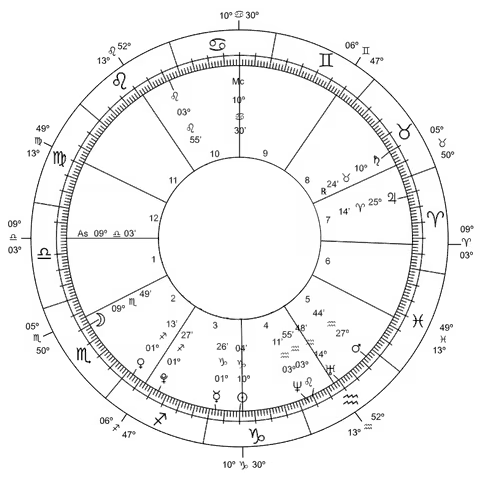
In a birth chart, aspects are the angles planets make with each other. They reveal where the various sides of your personality cooperate and where they collide. A chart without aspects would just be a list of unconnected placements; the aspects are what bind them into a whole.
Major Aspects
Conjunction
0° · Orb: 8-10°
So what is a conjunction in astrology? It occurs when two planets occupy the same degree of the zodiac, merging their energies into a single, concentrated force. Because the planets involved give up their separate edges and act as one, it is the most powerful aspect in a birth chart. Whether that turns out well or badly rests wholly on which planets are combined. Two benefics side by side bring good fortune, while two malefics side by side magnify trouble.
Sextile
60° · Orb: 4-6°
What does a sextile mean in astrology? When two planets are 60 degrees apart they form a sextile, which normally joins signs whose elements get along (fire with air, earth with water). It opens a path of opportunity and smooth communication between the two planets. A trine runs by itself, but a sextile needs a little effort from you before it switches on. When you do make that effort, the outcome is usually creative and productive.
Square
90° · Orb: 6-8°
What does a square mean in astrology? Two planets 90 degrees apart form a square, a strained bond full of friction between their energies. Squares join signs of the same modality (cardinal, fixed or mutable) whose elements clash, setting up an inner conflict that drives you to take action. It is the aspect of challenge and growth: the pressure is genuine, and it makes you stronger.
Trine
120° · Orb: 6-8°
What does a trine mean in astrology? A trine forms between two planets 120 degrees apart, joining signs that share an element. Of the major aspects it is the most harmonious, letting energy move easily between the planets. Trines indicate inborn gifts and natural abilities. Which element they share sets the tone: fire trines give creative confidence, earth trines give practical skill, air trines give mental ease and water trines give emotional depth.
Opposition
180° · Orb: 8-10°
What does an opposition mean in astrology? It forms when two planets are 180 degrees apart, facing each other across the chart. The result is a see-saw in which the two energies tug in opposite directions, often playing out through relationships and outside events. Oppositions connect complementary signs, such as Aries-Libra and Taurus-Scorpio, and the task is to find the balance point between two needs that are both legitimate.
Minor Aspects
Quincunx
150° · Orb: 2-3°
What does a quincunx mean in astrology? Also known as an inconjunct, a quincunx forms when two planets are 150 degrees apart, joining signs with no shared element, modality or polarity. What you get is an awkward, confusing link, because the two planets just do not speak the same language. It is the aspect of adjustment, calling for ongoing fine-tuning to bring together two basically different ways of working.
Semi-Sextile
30° · Orb: 1-2°
What does a semi-sextile mean in astrology? It forms when two planets are 30 degrees apart, linking signs that sit next to each other. Neighbouring signs always differ in element and modality, and often in polarity, so this aspect sets up a gentle, low-level friction between the planets. It is the aspect of quiet, gradual growth, where small adjustments build into real change over time.
Quick Reference
| Aspect | Symbol | Angle | Orb | Type | Quality |
|---|---|---|---|---|---|
| Conjunction | ☌︎ | 0° | 8-10° | Major | Neutral |
| Sextile | ⚹︎ | 60° | 4-6° | Major | Harmonious |
| Square | □ | 90° | 6-8° | Major | Dynamic |
| Trine | △ | 120° | 6-8° | Major | Harmonious |
| Opposition | ☍︎ | 180° | 8-10° | Major | Dynamic |
| Quincunx | ⚻︎ | 150° | 2-3° | Minor | Dynamic |
| Semi-Sextile | ⚺︎ | 30° | 1-2° | Minor | Neutral |
How Aspects Work in a Birth Chart
Each aspect has an orb of influence, meaning a range of degrees inside which it counts as active. The tighter the orb, the stronger and more noticeable the effect; a wider orb gives a softer, background influence. The five major aspects (conjunction, sextile, square, trine, opposition) are the backbone of chart reading, and the minor aspects add finer shades and detail.
An aspect can be applying, when the faster planet is heading towards the exact angle, or separating, when it is moving away from it. Applying aspects show energy that is still building to a peak, whereas separating aspects describe situations that are already winding down. Some astrologers treat applying aspects as more important, seeing them as livelier and stronger.
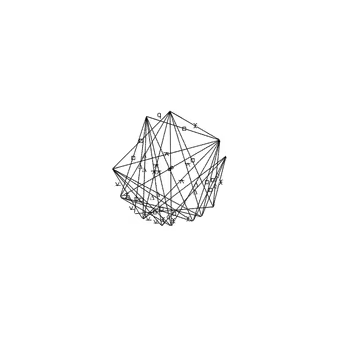
When several aspects join three or more planets, they create aspect patterns like the Grand Trine, T-Square, Grand Cross and Yod. These shapes set up complex dynamics that mark out the main themes of a person's life, and they are often the most telling part of a birth chart.
Explore More Western Astrology
Aspects link the planets in your chart, and those planets work through the zodiac signs and the houses. To read a chart properly, you need all four together.
Your Aspect Patterns
Want to know about the aspects in your own birth chart? An AI chat that picks out your main aspect patterns and explains how they shape your personality and life path is planned for Astro GPT, but it is not live yet.
Begin your journey with Astro GPT.
Ask your first question and see what your kundli says about the road ahead.